|

Mitsubishi spent years of research to determine the most
efficient pattern of in-cylinder airflow. The patented
"clockwise tumble" flow of the Mitsubishi GDI engine is the
result.
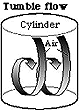
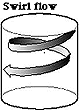
Tumble vs. Swirl
Conventional engines create "swirl" airflow. But this takes
the fuel around the outside of the cylinder. It's impossible
to concentrate the fuel, so it doesn't always burn
completely.
Tumble-shaped airflow solves this problem. The tumble shape
breaks up as the cylinder compresses, forming small
typhoon-like eddies. These enable fuel to be concentrated
around the sparkplug, for outstanding combustion efficiency
even with extremely lean air-fuel ratios.
A tumble pattern was employed on the Mitsubishi Vertical
Vortex (MVV) lean-burn engine. However, counter-clockwise
tumble was not feasible for direct injection.
|
|
|
Why does it have to be clockwise?
If the air tumbles counter-clockwise, it will carry
a directly injected fuel spray into the sparkplug,
creating a soot buildup that leads to misfires.
Also, counter-clockwise flow doesn't allow time for
a directly injected spray of petrol to vaporise.
These problems were solved by the invention of the
Upright Straight Intake Ports, which enabled
"clockwise tumble."
|
|


